


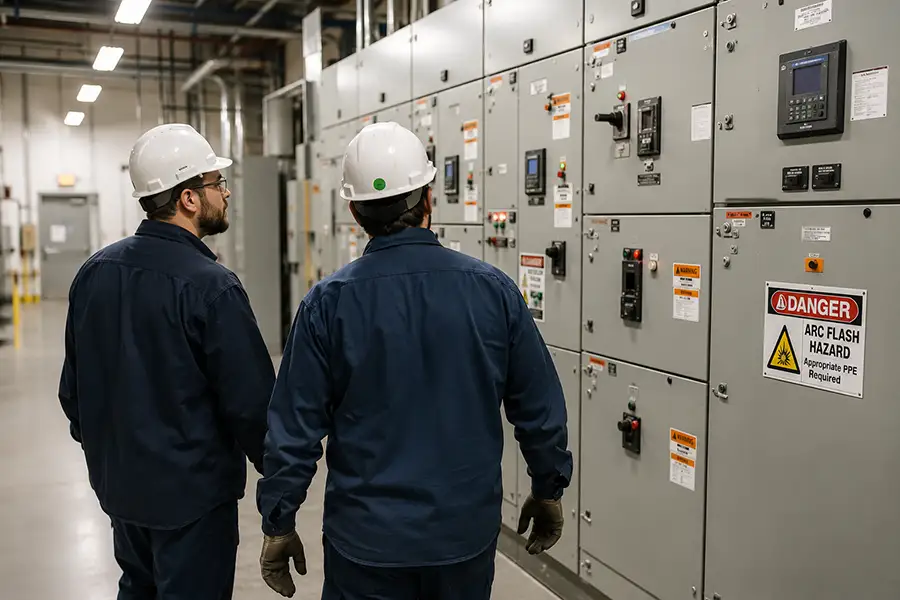
Electrical systems are the backbone of commercial and industrial facilities, but they also present serious safety risks if not properly evaluated and maintained. One of the most important engineering assessments for electrical safety is an arc flash study.
Whether your facility relies on backup generators, automatic transfer switches (ATS), UPS systems, or complex switchgear, an arc flash study helps identify potential hazards, improve worker safety, and support compliance with industry standards.
If your electrical system has changed over time, or if you have never completed an arc flash study, now may be the right time to evaluate your facility.
What Is an Arc Flash Study?
An arc flash study is an engineering analysis that evaluates an electrical power distribution system to determine the potential incident energy that could be released during an arc flash event. The study also establishes the appropriate personal protective equipment (PPE), arc flash boundaries, and equipment labeling requirements.
An arc flash occurs when electrical current travels through the air between energized conductors or from a conductor to ground. The resulting release of energy can generate extreme temperatures, intense pressure waves, molten metal, and flying debris within a fraction of a second.
An arc flash study is designed to help facilities:
- Identify locations with elevated arc flash hazards
- Calculate incident energy levels throughout the electrical system
- Determine appropriate PPE requirements for qualified workers
- Produce compliant arc flash warning labels
- Improve electrical safety procedures
- Support compliance with NFPA 70E and applicable OSHA requirements
Learn more about Global Power Supply’s Arc Flash Study Services
When Is an Arc Flash Study Required Under NFPA 70E?
One of the most common questions facility managers ask is when is an arc flash study required?
While OSHA does not specifically mandate an arc flash study, employers are required to provide a workplace free from recognized electrical hazards. NFPA 70E provides the industry consensus standard for electrical safety in the workplace and requires an arc flash risk assessment before employees perform work on or near energized equipment.
Additionally, the Authority Having Jurisdiction (AHJ) will typically require an arc flash study to close out a building permit.
An arc flash study is generally recommended:
- For new commercial or industrial facilities
- Before commissioning new electrical distribution equipment
- DFollowing major electrical system upgrades
- After generator, transformer, or switchgear replacements
- When adding or modifying electrical loads
- Following changes to utility service
- Periodically to ensure the analysis remains accurate as the electrical system evolves
An arc flash study is one of the primary tools used to support an NFPA 70E electrical safety program because it provides the engineering analysis needed to determine incident energy levels, establish arc flash boundaries, and produce equipment labels that help qualified workers select the proper PPE before performing energized work.
It is important to note that NFPA 70E expects facilities to keep their electrical safety information current. If electrical distribution equipment has been modified, protective device settings have changed, or new generators, transfer switches, or major loads have been added, the existing arc flash study should be reviewed and updated to reflect the current electrical system.
Backup Power Systems Can Change Arc Flash Hazard Levels
Backup power systems play a significant role in electrical system performance during fault conditions.
Facilities utilizing diesel generators, UPS systems, paralleling switchgear, or multiple power sources often have more complex fault current calculations than facilities served solely by utility power.
A comprehensive arc flash hazard analysis evaluates how various operating conditions influence available fault current and incident energy throughout the system. This is especially important for facilities that can operate from either utility power or onsite generation.
Proper engineering analysis helps ensure that arc flash labels remain accurate regardless of normal or emergency operating configurations.
Which Facilities Benefit Most from Arc Flash Studies?
Virtually any commercial or industrial facility with medium or low-voltage electrical distribution equipment can benefit from an updated arc flash study.
Industries commonly requiring these engineering services include:
- Manufacturing facilities
- Healthcare facilities
- Distribution centers
- Water and wastewater treatment plants
- Oil and gas operations
- Food processing facilities
- Universities and campuses
- Municipal facilities
- Critical infrastructure
For example, manufacturing facilities often undergo equipment upgrades, production line expansions, and electrical modifications that can significantly change arc flash calculations over time.
What Does an Arc Flash Study Include?
A professional arc flash study typically includes several engineering tasks to accurately model the electrical system and calculate potential hazards.
Typical project scope includes:
- Collection of electrical equipment nameplate data
- Utility coordination and fault current information
- One-line diagram verification or creation
- Electrical system modeling
- Protective device coordination review
- Incident energy calculations
- Arc flash boundary calculations
- Arc flash warning labels
- Final engineering report with recommendations
The accuracy of the study depends heavily on collecting complete field data and verifying that the electrical system reflects actual operating conditions.
What Does an Industrial Arc Flash Study Cost?
Many organizations ask about arc flash study cost for industrial facilities. The answer depends on several factors, including the size of the facility, the number of electrical distribution panels, the quantity of switchgear and transfer switches, the number of generators and alternate power sources, the overall complexity of the electrical distribution system, the availability of accurate one-line drawings, and the amount of field data collection required to accurately model the system.
Because every electrical infrastructure is unique, there is no one-size-fits-all price for an arc flash study. Facilities with multiple buildings, redundant power systems, emergency generators, UPS systems, or complex switchgear configurations typically require a more comprehensive engineering analysis than smaller or less complex installations.
Rather than focusing solely on the initial cost, organizations should consider the long-term value of an accurate arc flash study. A properly performed study helps improve worker safety, supports compliance with industry standards, provides current arc flash labeling, and ensures the electrical system can be maintained and modified with greater confidence for years to come.
Partner with Experienced Arc Flash Study Engineers
An arc flash study is much more than a compliance exercise. It is a critical engineering assessment that helps facilities identify electrical hazards, improve worker safety, support safe maintenance practices, and ensure electrical systems continue operating as intended after equipment modifications and facility expansions.
Producing an accurate study requires experienced electrical engineers who understand power system modeling, protective device coordination, backup power systems, and current industry standards. From straightforward electrical distribution systems to complex infrastructures involving generators, UPS systems, switchgear, automatic transfer switches, and multiple utility sources, every facility presents unique engineering challenges that must be carefully evaluated.
If your facility has recently installed new backup power equipment, expanded operations, modified its electrical distribution system, or has not updated its arc flash study in several years, it may be time to have your system reviewed.
Global Power Supply provides comprehensive arc flash studies for commercial and industrial facilities throughout the United States. Our experienced engineering team can perform arc flash studies as a standalone engineering service or incorporate them into a complete turnkey power system project that includes design, equipment procurement, installation, commissioning, and ongoing maintenance. Whether your electrical system is simple or highly complex, we deliver practical, accurate engineering analyses that help improve safety, support compliance, and provide greater confidence in your critical power infrastructure.