


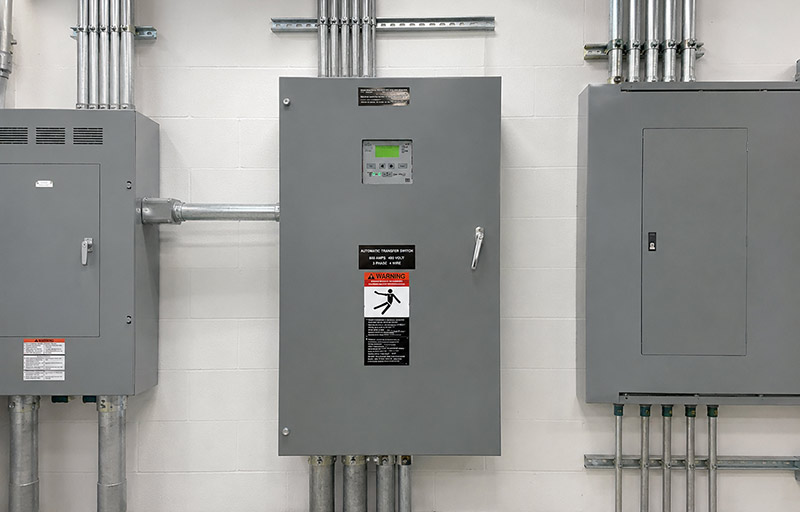
Automatic transfer switches are a critical component of many commercial and industrial backup power systems. When utility power fails or moves outside acceptable parameters, an automatic transfer switch (ATS) transfers connected loads to an alternate power source, typically a standby generator. When acceptable utility power returns, the ATS can transfer the load back to the normal source.
While the basic function is straightforward, there are several types of automatic transfer switches, and the correct configuration depends on the facility, connected loads, electrical system design, and operational requirements.
This guide explains the primary ATS transition types used in commercial and industrial facilities, along with enclosure ratings, service-entrance configurations, 3-pole versus 4-pole designs, and other factors to consider when selecting an automatic transfer switch.
ATS Transition Types Explained
The primary difference among ATS transition types is what happens electrically as the load moves from one power source to another.
Open-Transition Automatic Transfer Switch
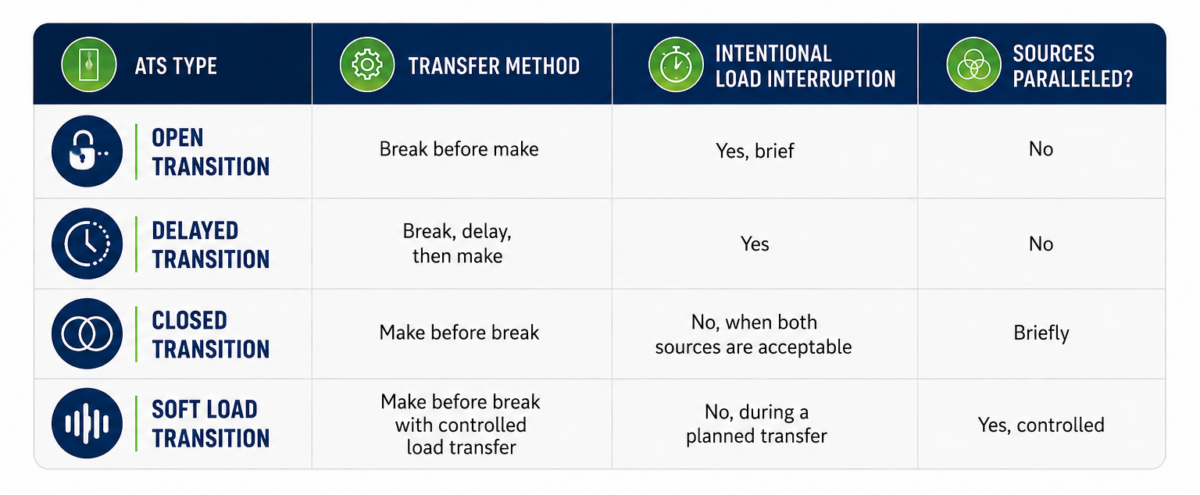
Open transition is a break-before-make transfer method. The ATS disconnects the load from the source currently supplying it before connecting the load to the alternate source. This prevents the normal and alternate sources from being electrically connected through the transfer switch.
Because the load is briefly disconnected from both sources, there is a momentary interruption during transfer.
Open-transition automatic transfer switches are widely used in commercial and industrial standby power systems where connected loads can tolerate this brief interruption. Applications can include commercial buildings, manufacturing facilities, warehouses and distribution centers, water and wastewater facilities, and many other industrial operations.
For many conventional standby generator applications, open transition provides a straightforward method of automatically transferring loads between utility and generator power without intentionally paralleling the 2 sources.
Delayed-Transition Automatic Transfer Switch
Delayed transition is a form of open transition that intentionally keeps the load disconnected from both sources for a controlled period before connecting it to the alternate source.
This delay can be useful with motors and other inductive loads that retain residual voltage after being disconnected. Allowing that voltage to decay before connecting the load to another source can help reduce undesirable electrical and mechanical stresses.
The tradeoff is a longer interruption, so delayed transition is typically selected because of specific load characteristics rather than simply to minimize transfer time.
Closed-Transition Automatic Transfer Switch
A closed-transition ATS uses make-before-break operation when both sources are available and acceptable. The switch momentarily connects the normal and alternate sources in parallel before disconnecting the source that is no longer required.
The key difference in an open transition vs. closed transition transfer switch is therefore whether the load experiences an intentional interruption during a normal transfer between 2 available sources.
Closed transition can be useful for facilities where an interruption during planned testing or retransfer is undesirable, including certain data centers, hospitals and healthcare facilities, and critical industrial operations.
Closed transition does not eliminate the outage associated with a complete loss of utility power while a standby generator starts. Its interruption-free benefit applies when both sources are available, acceptable, and properly synchronized for transfer.
Soft Load Transfer Switch
A soft load transfer switch uses controlled paralleling to gradually shift load between the utility and generator.
Unlike a conventional closed-transition ATS, which parallels sources only briefly, a soft-load system coordinates generator loading while the sources operate in parallel, allowing load to be transferred between sources in a controlled manner.
In a soft load transfer switch comparison, the primary advantage is controlled load transfer rather than simply eliminating the intentional transfer interruption. Soft-load systems may be considered for large loads, generator paralleling systems, and other engineered applications where transferring a large block of load at once is undesirable.
Because this involves extended utility-generator paralleling, soft-load transfer requires additional system engineering, controls, protection, and utility coordination.
Comparing Automatic Transfer Switch Transition Types

What Else Matters When Selecting an Automatic Transfer Switch?
Transition type is only one part of automatic transfer switch for generator selection. An ATS also needs to be properly matched to the electrical system and application.
Important considerations include:
- Ampere rating
- System voltage and frequency
- Number of phases
- 3-pole or 4-pole configuration
- Enclosure Type
- Service-entrance requirements
- Available fault current and withstand and closing rating (WCR)
- Generator and load characteristics
- Control and communications requirements
- Applicable electrical and facility requirements
For critical applications, the ATS should be evaluated as part of the overall electrical system rather than as an isolated component.
Automatic Transfer Switch Enclosure Types
The enclosure protects the ATS from environmental conditions at its installation location. Common NEMA enclosure Types for commercial and industrial transfer-switch applications include NEMA Type 1, Type 3R, Type 4, Type 4X, and Type 12, depending on manufacturer and product family.
NEMA Type 1
NEMA Type 1 is intended for indoor use and is commonly used in clean, dry electrical rooms and other protected indoor environments.
NEMA Type 3R
NEMA Type 3R can be used indoors or outdoors and provides protection appropriate for exposure to weather conditions such as rain, snow, and sleet. It is a common choice for outdoor ATS installations.
NEMA Type 4 and Type 4X
NEMA Type 4 provides additional protection against conditions including windblown dust and rain, splashing water, and hose-directed water.
NEMA Type 4X adds corrosion protection and may be appropriate for more corrosive industrial, coastal, water-treatment, and process environments.
NEMA Type 12
NEMA Type 12 is an indoor enclosure type commonly used in industrial environments requiring greater protection from conditions such as circulating dust, lint, fibers, and certain dripping or light splashing conditions.
The correct enclosure should be selected based on the actual installation environment and manufacturer specifications, not simply whether the ATS is located indoors or outdoors.
What Is a Service-Entrance-Rated Automatic Transfer Switch?
A service-entrance-rated ATS is designed to serve as both an automatic transfer switch and service-entrance equipment. In simple terms, it can combine the functions of transferring power between the utility and backup source with the main service disconnect for the facility.
This can simplify the electrical system by reducing the need for separate service-disconnect equipment upstream of the transfer switch. Having a service-entrance-rated disconnect can also provide greater flexibility for scheduled maintenance by allowing certain downstream equipment to be safely isolated without requiring a utility shutdown.
Not every ATS is rated for this purpose. If a transfer switch will be used as service-entrance equipment, it must be specifically designed and listed for that application. The system’s grounding, bonding, overcurrent protection, and overall electrical design must also be considered.
3-Pole vs. 4-Pole Automatic Transfer Switches
For a 3-phase electrical system, automatic transfer switches are commonly available in 3-pole and 4-pole configurations.
A 3-pole ATS switches the 3 phase conductors between power sources while the neutral remains connected. A 4-pole ATS switches the neutral as well.
Which configuration is required depends on how the facility’s electrical system is designed, particularly its grounding arrangement. This is an important consideration because using the correct configuration helps ensure the ATS works properly with the overall electrical system.
For most projects, the electrical engineer or electrical contractor will specify whether a 3-pole or 4-pole automatic transfer switch is required.
Which ATS Type Does Your Application Need?
For many commercial and industrial standby applications, an open-transition automatic transfer switch provides an effective and straightforward solution because it transfers the load without intentionally paralleling utility and generator sources
Other applications may require more specialized transfer methods:
- Delayed transition can address residual voltage concerns associated with certain motors and inductive loads.
- Closed transition can avoid an intentional interruption during planned transfers when both sources are available and acceptable.
- Soft-load transfer can provide controlled load transfer between sources in more complex generator paralleling applications.
The final decision should account for the facility’s load characteristics, generator system, grounding design, operational requirements, and applicable electrical requirements.
Finding the Right Automatic Transfer Switch
Selecting the right ATS requires matching the transition type, amperage, voltage, pole configuration, enclosure, and other specifications to the facility’s electrical system. Equipment availability can also become an important consideration when a project is working against a tight construction schedule or replacing existing equipment.
Global Power Supply maintains a large inventory of automatic transfer switches from established manufacturers, including ASCO, Thomson Power Systems, and ABB. Typical inventory includes 3-pole and 4-pole automatic transfer switches from 100 A through 4000 A, with a strong selection of open-transition models. Larger sizes and specialized configurations can also be sourced for specific project requirements.
Need help sourcing an ATS for your project? Explore available automatic transfer switches or speak with our team about your requirements and current equipment availability.