


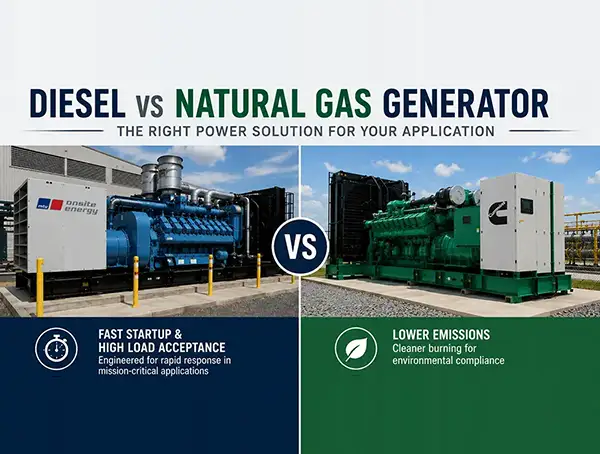


Selecting between a diesel vs natural gas generator is a fundamental design decision that impacts system reliability, operating cost, regulatory compliance, and long-term performance. While both fuel types are widely used in commercial and industrial applications, their differences become more pronounced when evaluated against specific operational requirements.
Rather than viewing this as a general preference, the decision should be based on how each technology performs across key criteria such as startup response, fuel availability, maintenance demands, and infrastructure dependency.
Diesel vs Natural Gas Generator: Core Operating Characteristics
Diesel and natural gas generators differ primarily in how they store, deliver, and convert fuel into power.
Diesel generators operate using stored liquid fuel with high energy density, enabling rapid combustion and immediate load acceptance. This makes them inherently well-suited for standby applications where fast response is critical.
Natural gas generators rely on a continuous fuel supply delivered through utility infrastructure. While this eliminates the need for onsite fuel storage, it introduces dependency on gas pipeline availability, pressure, and overall utility reliability.
Both systems can be engineered for standby, prime, or continuous duty, but their performance characteristics influence where each is most effective.
Diesel or Natural Gas Generator Pros and Cons
Diesel Generators
Learn more about available options: https://www.globalpwr.com/diesel-generators/
Diesel generators are widely regarded as the standard for emergency backup power due to their predictable performance and independence from external fuel delivery systems. The ability to store fuel onsite provides a controlled and reliable energy source, particularly in scenarios where utility infrastructure may be compromised.
From a performance standpoint, diesel engines deliver strong transient response and high load acceptance, allowing them to stabilize critical systems quickly following a power loss. This is a key reason they are commonly deployed in mission-critical environments such as data centers and healthcare facilities.
However, this reliability comes with additional considerations. Fuel storage systems must be properly designed, permitted, and maintained. Diesel fuel is subject to degradation over time, requiring periodic testing and conditioning to ensure system readiness. Emissions compliance is also a factor, particularly for non-emergency or continuous-use applications.
Natural Gas Generators
Explore options here: https://www.globalpwr.com/natural-gas-generators/
Natural gas generators are often selected for applications where long-duration runtime and reduced emissions are primary considerations. By utilizing a direct connection to a utility gas line, these systems eliminate the logistical and maintenance challenges associated with liquid fuel storage.
Advancements in engine control systems and fuel delivery technologies have improved the performance of natural gas generators, making them viable for a broader range of commercial and industrial applications. They are particularly effective in locations with stable gas infrastructure and where environmental regulations favor lower-emission solutions.
The primary limitation is their dependence on external fuel supply. Gas availability, pressure constraints, and potential service interruptions must all be evaluated as part of the system design. Additionally, natural gas generators generally exhibit slower startup and load acceptance characteristics compared to diesel systems, which can influence their role in critical backup configurations.
Natural Gas Generator vs Diesel Cost
When evaluating natural gas generator vs diesel cost, consider both capital and operational expenses:
Upfront Costs
- Diesel generators are often less expensive to install in smaller applications
- Natural gas systems may require gas line upgrades, pressure regulation, and permitting
Fuel Costs
- Natural gas is typically less expensive per BTU than diesel in many regions
- Diesel prices are more volatile and influenced by transportation and storage
Maintenance Costs
- Diesel requires more fuel-related maintenance
- Natural gas systems may have longer service intervals but still require engine maintenance
Total Cost of Ownership
- Diesel often wins in standby applications with infrequent use
- Natural gas can be more economical for continuous or prime power applications


Reliability, Availability, and Startup Performance
System reliability is closely tied to fuel accessibility and startup performance.
Diesel generators provide a self-contained solution, with onsite fuel ensuring availability regardless of external infrastructure conditions. This independence is a key factor in their continued use in high-reliability applications
Natural gas generators offer effectively unlimited runtime under normal conditions, but their performance is directly tied to the reliability of the gas utility. In scenarios involving natural disasters or infrastructure disruptions, this dependency can become a risk factor.
Startup performance further differentiates the two. Diesel generators are capable of rapid start and immediate load acceptance, while natural gas generators have historically exhibited slower startup characteristics. As a result, both diesel and natural gas generators are commonly integrated with UPS systems in mission-critical environments to ensure seamless power continuity during the transition from utility power to generator supply.
Dual-Fuel Generators: Combining Diesel Reliability with Natural Gas Efficiency
Dual-fuel generator systems are becoming increasingly common in large commercial and industrial applications where operators want to improve fuel efficiency without sacrificing the reliability traditionally associated with diesel engines.
In most commercial configurations, a dual-fuel system consists of a diesel generator retrofitted with a natural gas blending system. During startup, the engine operates on 100% diesel fuel because diesel ignition relies on compression, while natural gas requires significantly higher temperatures to combust effectively. Once the engine reaches operating temperature and stabilizes under load, the control system introduces natural gas into the engine air intake.
At that point, the generator begins displacing a substantial portion of the diesel fuel consumption, often replacing approximately 50% to 70% of the required diesel with natural gas depending on engine design, load conditions, and fuel quality.
One of the primary advantages of this approach is fuel cost optimization. By supplementing diesel with lower-cost natural gas, facilities can reduce operating expenses while also lowering overall emissions. At the same time, the engine retains the performance characteristics and load acceptance capability of a conventional diesel generator.
Another major benefit is operational resilience. If the natural gas supply pressure fluctuates or utility gas service is interrupted, the system automatically transitions back to 100% diesel operation without interrupting power output. This seamless fuel transition allows the generator to maintain stable performance even during changing fuel conditions.
Dual-fuel systems can also significantly extend runtime during prolonged outages. Because the generator consumes diesel at a reduced rate, onsite fuel storage lasts considerably longer compared to a traditional diesel-only configuration. For facilities concerned about fuel logistics during extended utility outages, this can provide a meaningful operational advantage.
NFPA 110 Compliance: Diesel vs Natural Gas Generators
For critical applications such as healthcare and life safety systems, compliance with NFPA 110 is a defining requirement in generator selection.
NFPA 110 specifies performance criteria for emergency power systems, including Type 10 classification, which requires that power be restored to designated loads within 10 seconds of an outage.
Diesel generators have historically been the preferred solution for meeting these requirements due to their inherent ability to start quickly and accept load without delay. Their mechanical simplicity and fuel characteristics support consistent performance under stringent conditions.
Modern natural gas generators, however, have evolved significantly. Several major manufacturers now offer systems specifically engineered to meet NFPA 110 Type 10 requirements. Improvements in fuel injection, electronic governing, and engine management systems allow these generators to achieve the necessary startup and load acceptance performance for life-safety applications.
When properly designed and integrated, both diesel and natural gas generators can meet NFPA 110 standards. The determining factor is not solely the fuel type, but how the complete system is engineered, tested, and maintained, including coordination with transfer switches and UPS systems.
Maintenance Considerations
Maintenance strategy plays a critical role in long-term system reliability.
Diesel generators require active fuel management, including periodic testing, conditioning, and inspection to prevent degradation. Mechanical components must also be exercised regularly to ensure readiness.
Natural gas generators eliminate fuel storage concerns but introduce different maintenance priorities, including ignition systems, valve adjustments, and combustion tuning. While the maintenance profiles differ, both systems require structured preventive maintenance programs to ensure consistent performance and compliance with operational standards.
Diesel Generator vs Natural Gas for Data Centers


Learn more about data center power solutions: https://www.globalpwr.com/solutions/data-centers/
In data center environments, where uptime requirements are measured in fractions of a second, diesel generators remain the dominant solution. Their ability to start quickly and stabilize load makes them well-suited for Tier III and Tier IV facilities.
Natural gas generators may be incorporated in certain designs, particularly where extended runtime is a priority, but they are typically part of a broader system architecture rather than a direct replacement.
Regardless of fuel type, generators are deployed alongside UPS systems to ensure uninterrupted power during the transition from utility failure to generator operation. This layered approach is essential for maintaining continuous operation in critical IT environments.
Diesel vs Natural Gas for Distribution and Warehousing
Learn more about power solutions for distribution centers: https://www.globalpwr.com/solutions/warehousing-distribution/
Distribution and warehousing facilities depend on consistent power to maintain throughput, inventory systems, and automated material handling. While these environments may not always be classified as mission-critical in the same way as data centers, unplanned outages can quickly disrupt operations, delay shipments, and impact revenue.
Diesel generators are commonly deployed in these facilities due to their reliability, fast startup, and ability to support large motor loads such as conveyors, sortation systems, and refrigeration equipment. Their independence from utility fuel infrastructure also provides an added layer of resilience, particularly in regions prone to grid instability.
Natural gas generators are a viable option in locations with reliable gas service, especially for facilities that require extended runtime or operate in emissions-sensitive areas. They are often considered for prime or continuous power applications where fuel cost and environmental considerations are a priority.
In many distribution environments, generators are integrated with UPS systems to support critical controls, IT infrastructure, and automation systems. This ensures that even brief interruptions do not result in system resets, data loss, or operational downtime.
Diesel vs Natural Gas for Hospitals and Healthcare
Learn more about power solutions for distribution centers: https://www.globalpwr.com/solutions/hospitals-healthcare/
Healthcare facilities represent one of the most stringent use cases for backup power, where system performance directly impacts patient safety. Emergency power systems must comply with strict regulatory standards, including NFPA 110 requirements for rapid startup and reliable load transfer.
Diesel generators remain the primary choice for hospital backup power systems due to their proven ability to meet these requirements consistently. Their fast response and high load acceptance capability make them well-suited for supporting life-safety systems, critical care equipment, and essential facility operations during an outage.
Natural gas generators can be incorporated into healthcare power strategies, particularly in applications where extended runtime is required or where dual-fuel redundancy is part of the design. However, they are typically implemented as part of a broader system architecture rather than as a standalone replacement for diesel in life-safety roles.
As with other critical environments, both diesel and natural gas generators are deployed alongside UPS systems to ensure uninterrupted power to sensitive medical equipment and IT systems during the transition period. This layered approach is essential for maintaining continuity of care and operational stability in healthcare settings.
Which Generator Fuel Type Is Best?
Determining which generator fuel type is best requires aligning system capabilities with operational priorities.
Diesel generators are often selected where immediate response, high reliability, and independence from external infrastructure are required. Natural gas generators are well-suited for applications that prioritize extended runtime, emissions reduction, and access to stable fuel supply.
In many cases, the optimal solution is not based on fuel type alone, but on how the generator integrates into the overall power system, including redundancy, energy storage, and distribution design.
Making the Right Choice for Your Facility
Selecting the appropriate solution in a diesel vs natural gas generator comparison requires a detailed evaluation of site conditions, load requirements, and risk tolerance.
Global Power Supply supports this process through engineering analysis, equipment sourcing, and full project execution. With access to a large inventory of both diesel and natural gas generators across multiple manufacturers, solutions can be tailored to meet specific performance, budget, and compliance requirements.
Talk to an Engineer
Not sure which fuel type suits your site?
Talk to a Global Power Supply engineer for a free application consultation.
Get a technically grounded recommendation designed to optimize reliability, performance, and long-term value for your facility.