


Environmental regulations for diesel generators have grown increasingly complex. Facility leaders want certainty that their power systems are reliable, legally compliant, and engineered for long-term resilience. This guide breaks down how the EPA regulates standby diesel generators, clarifies the meaning of Tier 4 Final vs Tier 4 Certified vs Tier 4 Compliant, explains allowable operating hours for emergency standby use, and introduces two important concepts often overlooked in emissions discussions: standby rating vs prime rating and why the largest diesel generators are still manufactured to Tier 2 standards.
How EPA Tier standards evolved: Tier 1 through Tier 4 Final
EPA emissions standards for nonroad diesel engines have tightened steadily for more than twenty-five years. The progression looks like this:
- Tier 1: Introduced in the late 1990s.
- Tier 2: Rolled out in 2007 with limits on nitrogen oxides (NOx), particulate matter (PM), and hydrocarbons. Applies to standby generators above 450 kW.
- Tier 3: Rolled out in 2007 with limits stricter than Tier 2, but applies only to 37-450 kW standby generators.
- Tier 4 Interim (Tier 4i): Added in 2011 for larger engines to begin reducing particulate matter.
- Tier 4 Final (commonly referred to simply as Tier 4): The most stringent standard was fully implemented by 2015, requiring major reductions in NOx and PM.
Manufacturers and customers sometimes refer to “Tier 4 Final” and sometimes use “Tier 4.” Today, the term “Tier 4” is generally understood to represent the final and most advanced stage of rulemaking for this Tier.
The meaning of Tier 4 Certified vs Tier 4 Compliant
These two terms often cause significant confusion, yet the differences affect equipment selection and emissions permitting.
Tier 4 Certified
- The engine and complete generator package are tested, documented, and certified through the EPA’s official process by the OEM at the OEM’s Factory.
- Units carry EPA certification labels.
- Generally required for applications outside of true emergency standby use, including non-emergency, prime power, and any program involving demand response in parallel operation with the grid. This depends on the local Authority Having Jurisdiction (AHJ), state or region of operations.
- Not permittable to bypass DPF and/or SCR if they were to fail. Engine would not be able to run in the event either item failed.
Tier 4 Compliant
- 3rd Party Integration of aftermarket treatment products (i.e SCR and DPF) to achieve EPA Tier 4F equivalent emissions levels.
- Onsite testing is often required to verify emissions levels.
- Often acceptable in the same applications as Tier 4F Certified.
- Can be used to retrofit existing equipment.
- It is permittable to bypass diesel particulate matter filter and/or SCR solely if they were to fail. Engine could continue running in the event those items fail.
Standby rating vs prime rating: why it matters for emissions
Every diesel generator is rated according to its intended operating profile. The EPA refers to these categories when determining what emissions tier applies.
Standby Rating
- Intended for use only during utility outages.
- No limit on run hours during an actual outage.
- Strict limits on non-emergency hours, commonly 100 hours per year or less for testing and maintenance, but actual limits depend on local air-district rules.
- Because standby generators are expected to run infrequently, they are allowed to meet less stringent emission standards if classified strictly as emergency standby, typically Tier 2 or Tier 3.
Prime Rating
- Intended to run for extended periods and carry a variable load.
- Used when there is no utility power or in locations where regular, long-duration generator operation is required.
- Prime-rated generators fall under tighter emissions requirements because they accumulate significantly more operating hours.
- Prime power applications typically require Tier 4 Certified emissions unless located in very specific jurisdictions with exceptions.
Understanding your true operating profile is essential. If a facility exceeds allowable non-emergency hours on a standby generator, the engine can be reclassified as non-emergency. That reclassification can trigger Tier 4 requirements even if the generator was originally purchased for emergency use.
EPA Emergency vs Non-Emergency Classification (NSPS)
The US EPA New Source Performance Standards (NSPS) classify stationary engines based on brake horsepower and use type. These classifications determine which emissions standards apply and directly influence whether a generator can operate under Tier 2, Tier 3, or Tier 4 requirements.
Stationary vs Portable/Mobile
Stationary Engines
- The generator remains in one location for more than 12 months.
- These units must meet EPA stationary engine standards, which include the full tier structure.
Portable or Mobile Engines
- Designed to be moved from site to site.
- Must meet US EPA non-road engine standards, which follow a different compliance pathway than stationary engines.
Emergency Classification
Generators classified as emergency engines fall into what most organizations refer to as Standby units.
Characteristics include:
- The generator is not the primary source of power and operates only when the utility supply fails.
- There is unlimited runtime allowed during an actual utility outage.
- Maintenance and readiness testing are limited to 100 hours per year or less, depending on size of genset and/or local requirements.
- Any use outside true outage events must follow strict limits to retain emergency status.
This classification allows the use of Tier 2 or Tier 3 engines in many jurisdictions, provided the engine stays within emergency-only restrictions.
Non-Emergency Classification
Generators classified as non-emergency engines are commonly referred to as prime or continuous power systems.
Characteristics include:
- The generator is the primary power source, or
- The generator supplements the utility in applications such as peak shaving, interruptible rate programs, or any use that generates income by exporting power to the grid.
Non-emergency generators accumulate more annual operating hours, so the EPA requires significantly cleaner emissions performance. This is where Tier 4 Certified power systems and Emissions After Treatment Systems (EATS), such as SCR and DPF, become required in most regions.
How many hours can an emergency standby generator operate legally?
EPA rules allow emergency standby generators to run:
- Unlimited hours during a true utility outage.
- Limited hours for testing and maintenance, typically 100 hours per year or less, depending on jurisdiction and size of genset.
Running beyond those limits or using the generator for peak shaving, demand response, or load management changes the classification. Once that happens, Tier 4 Certified generators are required in most regions.
State and local air districts, especially in major metropolitan areas considered non-attainment zones, often impose even stricter caps. Always confirm local regulations before establishing test schedules or non-emergency use profiles to ensure compliance.
Why many of the largest diesel generators are only manufactured to EPA Tier 2
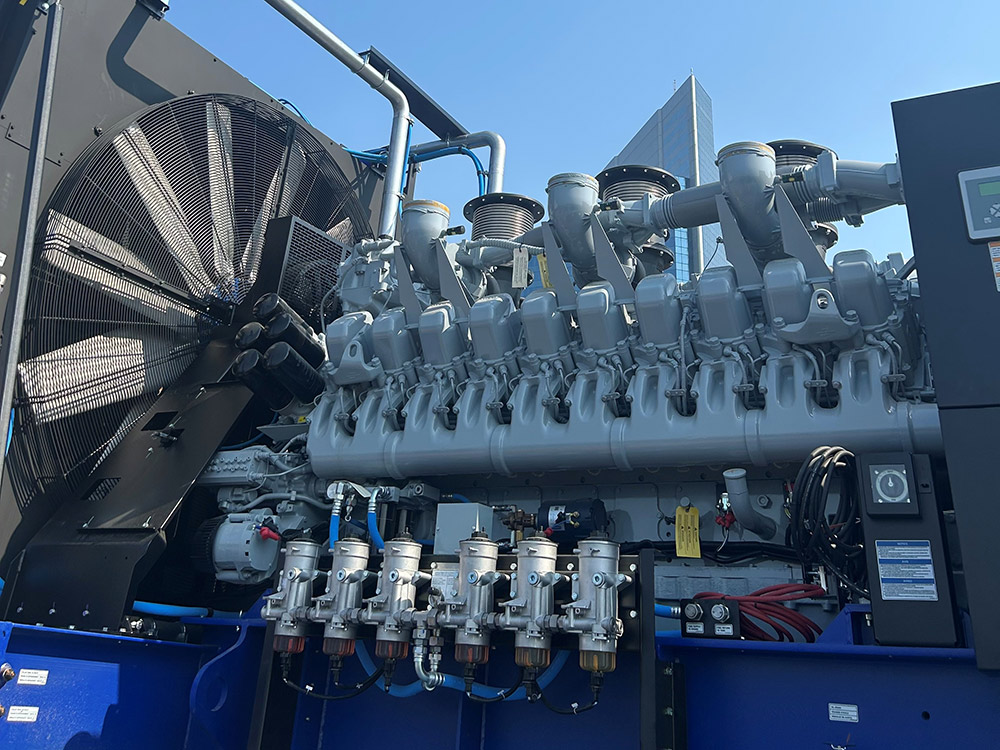
This is one of the most misunderstood topics in the power generation industry. Large standby diesel generators in the 500 kW to 4000 kW range, such as the Cummins DQKAN 2500 kW, are typically produced as Tier 2 engines from the factory. Three major factors drive this:
1. Engineering and combustion realities at very high horsepower
Engines exceeding approximately 1600 horsepower face significant challenges in meeting Tier 4 Final standards without after treatment. Achieving Tier 4 inside the engine alone would reduce efficiency, raise exhaust temperatures, and increase fuel consumption. Manufacturers design these large engines as Tier 2 to maintain durability, reliability, and stable power output under high loads.
2. Intended operational use
Large generators, ranging from 500 kW to 4 MW, are predominantly purchased for emergency standby applications in data centers, hospitals, industrial facilities, and utility infrastructure. Under EPA rules, emergency standby generators can use Tier 2 engines as long as they stay within emergency-only operating limits. Because they are not expected to run continuously, the emissions impact is limited.
3. After Treatment allows Tier 4 performance when required
Although the engine itself is Tier 2, the complete generator system can still achieve Tier 4 Final emissions when an Emissions After Treatment System (EATS) is installed. Two common technologies are:
- Selective Catalytic Reduction (SCR) for NOx reduction.
- Diesel Particulate Filter (DPF) for PM reduction.
When engineered correctly, SCR and DPF systems enable a Tier 2 engine to meet Tier 4 Final emissions levels. This approach has several advantages:
- Lower cost compared to building a ground-up Tier 4 engine.
- Proven reliability for high horsepower applications.
- Flexibility to meet differing state and local emissions rules.
- Ability to retrofit after installation if operating needs change.
This is why many large Tier 2 generator models are routinely integrated with after treatment systems for facilities that need prime power, extended operation, or stricter Tier 4 compliance.
The impact of local regulations: metro vs rural differences
EPA regulations are the national framework, but state and regional air districts often add their own rules. In major metropolitan areas, air quality challenges drive stricter limits on particulate matter and NOx. This means:
- Tier 4 Certified units may be required even for emergency use.
- Annual test hours may be capped below federal allowances.
- After treatment may be mandated on larger generators.
- Permit processes can be more extensive.
- Typically the local AHJ requires “Generator Log” book to record testing, outages and scheduled (OM) Operational Maintenance.
In rural regions or attainment zones, Tier 2 standby-only units may still be acceptable. This is why emissions compliance must always be evaluated at the local level, not just federally.
Choosing the right generator and emissions package
Your facility should consider:
- True operating profile: standby or prime.
- Location and applicable air district rules.
- Load requirements and peak demand conditions.
- Future expansion and potential use cases.
- Availability of after-treatment systems for Tier 4 Final compliance.
- Long-term cost of ownership, including permitting and fuel profile.
Selecting the correct rating and emissions tier from the beginning avoids costly redesigns, unexpected permitting issues, and operating restrictions later.
Support from Global Power Supply
Global Power Supply provides expert engineering, turnkey project management, and emissions compliance guidance for backup power systems. Our team helps evaluate your load profile, location, regulatory requirements, and operational goals to recommend the right generator rating and emissions strategy. From Tier 2 emergency systems to complete Tier 4 Final packages with SCR and DPF integration, we deliver solutions that keep your facility compliant and resilient.
Global Power Supply is committed to helping customers navigate complex regulations with clarity and confidence.