


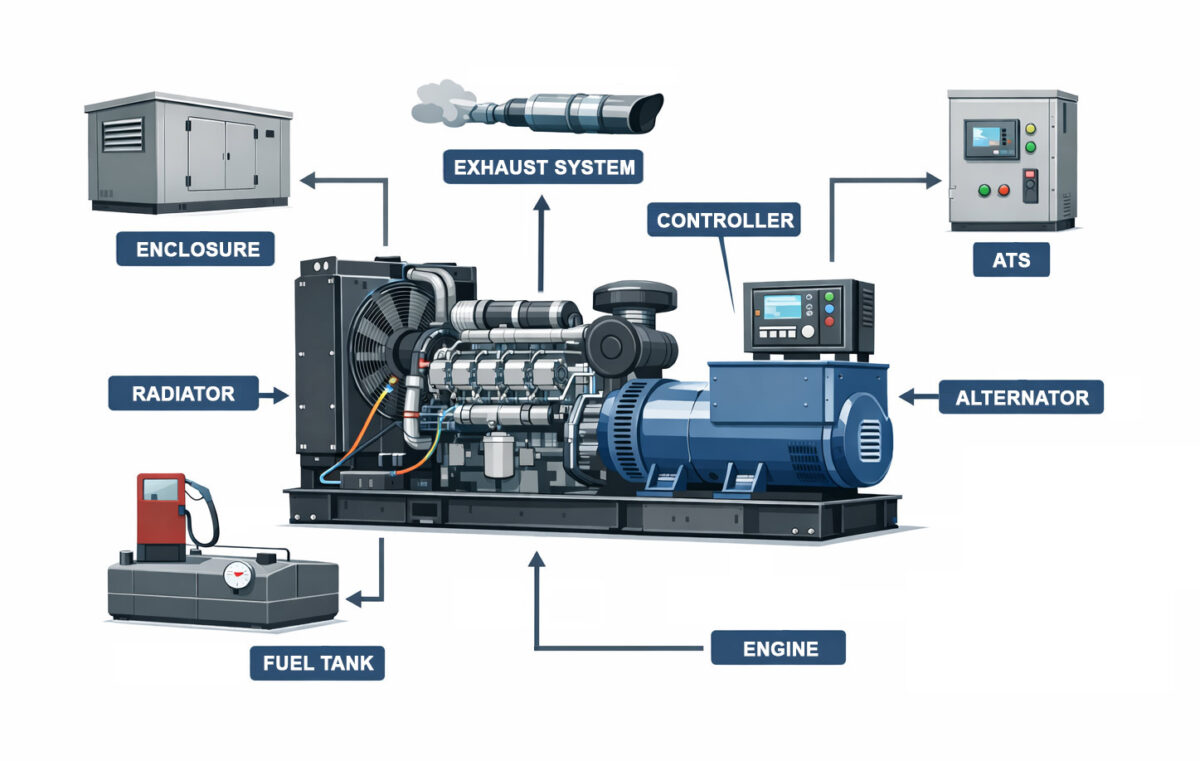
A generator set, often referred to as a generator or genset, is a critical piece of infrastructure for commercial and industrial facilities that require reliable power during utility outages or in off-grid applications. While generators are often discussed as a single unit, they are made up of several integrated components that must work together to deliver stable, reliable electrical power.
Understanding these core components helps facility managers, engineers, and decision-makers evaluate generator performance, reliability, and suitability for their specific application.
Below is an overview of the primary components of a commercial or industrial generator set and how each plays a role in the overall system.
Engine
The engine is the prime mover of the generator set. It converts fuel energy into mechanical energy, which drives the alternator to produce electricity. Commercial and industrial generators typically use diesel or natural gas engines due to their durability, efficiency, and ability to handle sustained loads. Engine size and design directly influence generator capacity, fuel consumption, and response time during load changes.
Key considerations include:
- Fuel type and availability
- Emissions compliance
- Load acceptance and performance under varying conditions
- Maintenance requirements and service intervals
Alternator
The alternator, sometimes called the generator end, converts the engine’s mechanical energy into electrical energy. As the engine rotates the alternator shaft, a magnetic field is created, inducing an electrical current.
The alternator plays a major role in:
- Power quality
- Efficiency under load
- Thermal performance
High-quality alternators are designed to handle non-linear loads, motor starting, and transient conditions commonly found in commercial and industrial facilities.
Controller/ AVR (Automatic Voltage Regulator)
The controller/ AVR is the operational brain of the generator set. It monitors system conditions and manages generator performance during startup, operation, and shutdown.
Modern generator controllers provide:
- Voltage stability
- Voltage and frequency regulation
- Automatic start and stop functions
- Alarm and fault monitoring
- Remote monitoring and diagnostics
- Integration with building management systems
Controllers/ AVRs are essential for ensuring safe operation and for coordinating the generator with other power infrastructure components.
Fuel System and Fuel Tank
The fuel system stores and delivers fuel to the engine at the correct pressure and volume. In commercial and industrial installations, the fuel tank is typically a separate but closely integrated component of the generator system.
Fuel system considerations include:
- Power quality
- Local and federal fuel storage regulations
- Fuel polishing and filtration
- Secondary containment and leak protection
Proper fuel system design is critical to ensuring the generator can operate continuously for the duration of an outage.
Cooling System
Generators create significant heat during operation. The cooling system removes this heat to prevent overheating and maintain reliable performance.
Cooling systems may be radiator-based, remote-mounted or heat exchanger-based depending on installation requirements and environmental conditions. Proper airflow and temperature control are especially important for generators installed in enclosures or indoor generator rooms.
Exhaust System
The exhaust system safely directs combustion gases away from the engine and the facility. It also helps manage noise and thermal output.
Commercial generator exhaust systems must be designed to meet safety codes, environmental regulations, and site-specific constraints.
Enclosure
While not directly involved in power generation, the enclosure protects the generator from environmental exposure and helps manage sound levels.
Enclosures can be:
- Weather-protective
- Sound-attenuated
- Designed for extreme hot or cold climates
For outdoor installations, enclosure design plays a significant role in long-term reliability and compliance with local noise ordinances.
Automatic Transfer Switch (ATS)
The automatic transfer switch is not part of the generator set itself, but it is a critical component of any backup power system.
The ATS monitors utility power and automatically transfers the electrical load to the generator during an outage. When utility power is restored, it returns the load and signals the generator to shut down.
The ATS ensures:
- Seamless power transfer
- Reduced downtime
- Safe isolation between utility and generator power
Without an ATS, generator systems would require manual intervention, increasing risk and response time during outages.
How These Components Work Together
When a utility power outage occurs, the ATS detects the loss of power and signals the generator controller to start the engine. The engine drives the alternator, which produces electricity regulated by the controller and delivered to the facility. Supporting systems such as fuel delivery, cooling, exhaust, and enclosure protection ensure stable operation for the duration of the outage.
Each component must be properly sized, integrated, and maintained for the system to perform as intended.
Supporting Commercial and Industrial Backup Power Systems
Global Power Supply works with commercial and industrial customers to design, source, and support generator systems that meet real-world operational demands. From complete generator sets and fuel systems to enclosures, controls, and transfer switches, solutions are tailored to protect critical operations and maintain continuity during power disruptions.
With expertise across multiple industries and applications, Global Power Supply helps businesses evaluate their power infrastructure and implement backup power solutions that align with performance requirements, regulatory standards, and long-term reliability goals.