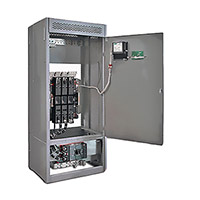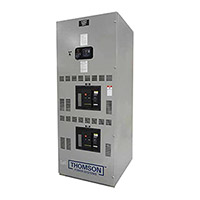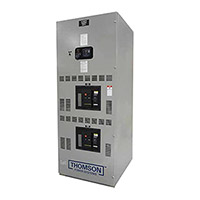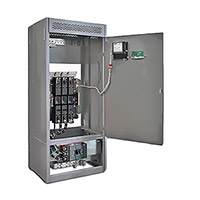

Automatic Transfer Switches for generators in emergency standby power solutions. Power transfer switches come in sizes from 30 AMP to 5000 AMP. In-stock in 3-pole and 4-pole configurations with both service entrance rated and manual switching options.
Global Power Supply stocks automatic transfer switches from ASCO and Thomson, two of the most established names in critical power transfer technology, alongside listings from ABB Zenith and other leading manufacturers. Units are available in amp ratings from 30A to 5000A, in 3-pole and 4-pole configurations, with service entrance rated options in stock.
Beyond supplying the switch itself, Global Power Supply’s engineering and field service teams support installation, startup testing, and ongoing maintenance for automatic transfer switches at facilities nationwide. Our in-stock inventory plus engineering and service support simplifies the entire process for facility managers while expediting the project by removing the need to hire multiple vendors
Ready to spec an ATS for your facility? Request a Quote from our team.
Frequently Asked Questions
What are the key considerations when selecting an Automatic Transfer Switch for critical infrastructure?
Considerations include transfer time, load capacity, and compatibility with the primary and secondary power sources. In critical infrastructure, the ATS must ensure minimal disruption during power transitions, often requiring closed transition or delayed transition switches.
How does an ATS integrate with modern power management systems?
ATS devices are typically integrated with power management systems via communication protocols like Modbus or SNMP. This allows for real-time monitoring, remote control, and automated reporting, essential for managing complex power grids.
What is the role of ATS in ensuring power continuity in redundant power systems?
In redundant power systems, ATS devices are crucial for automatically transferring loads between multiple power sources. This ensures continuous power availability, particularly in applications where any downtime could result in significant operational or financial losses.
What are the advantages of a bypass-isolation ATS in high-availability environments?
Bypass-isolation ATS units allow for maintenance or testing without interrupting power to the load. This is critical in environments where uptime is essential, such as data centers or healthcare facilities.
How do open and closed transition ATS devices differ in their operational impact?
Open transition ATS momentarily interrupts the power supply during transfer, which may not be suitable for sensitive loads. Closed transition ATS devices provide a seamless transfer with no interruption, making them ideal for critical applications.
What are the testing and maintenance requirements for ATS devices in mission-critical applications?
Regular testing, including monthly operational checks and annual full-load tests, is essential. Maintenance should follow manufacturer guidelines, focusing on ensuring the ATS’s mechanical and electrical components are in optimal condition.
How does an ATS contribute to compliance with industry standards and regulations?
ATS devices must comply with standards such as UL 1008 and NFPA 110. Proper installation, regular maintenance, and adherence to these standards ensure that the ATS contributes to overall system reliability and regulatory compliance.
What automatic transfer switch brands and amperage ranges does Global Power Supply have in stock?
Global Power Supply stocks automatic transfer switches from ASCO, Thomson, and ABB Zenith in amperage ratings from 100A to 4000A, in 3-pole and 4-pole configurations. Units are available in service entrance rated options, with new inventory added regularly. Contact our sales team for current availability on a specific rating or manufacturer.
Can Global Power Supply help size and install an automatic transfer switch?
Yes. Our in-house engineering team can help size an ATS to your facility’s load and code requirements, and our field service team handles installation, startup testing, and ongoing maintenance.