

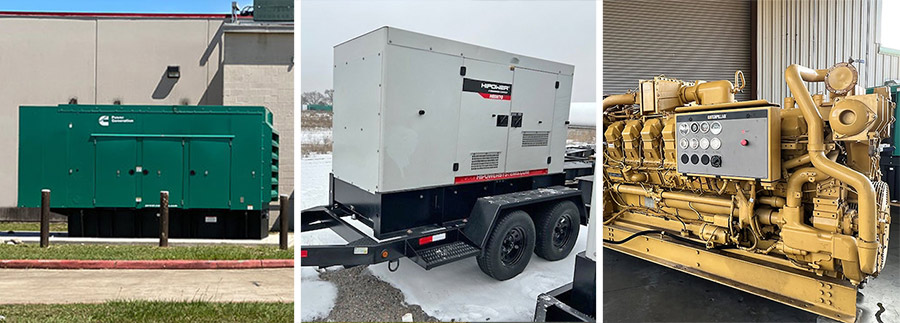
Standby, Prime, and Continuous Rated Generators (left to right)
When selecting a commercial or industrial generator, power rating is one of the most important factors to get right. Generator power ratings define how a unit is designed to operate, how long it can run, and under what load conditions. Choosing the wrong rating can lead to poor performance, pre-mature failures, noncompliance with codes or standards, and unexpected downtime.
Manufacturers define generator ratings according to established international standards, such as ISO 8528, and to guidelines commonly referenced by utilities, engineers, and regulatory authorities. While the generator may look similar externally, standby, prime, and continuous-rated units are built and configured differently to support their intended duty cycle.
Understanding these differences helps ensure the generator matches the application rather than being undersized or overworked.
Standby Power Rating
Standby power is the most common rating used for commercial and industrial backup generators. Under ISO 8528, standby power is defined as the maximum power available during a variable-load sequence when the normal utility power is interrupted.
Key characteristics of standby-rated generators include:
- Intended for emergency use only
- Designed to operate during utility outages
- Typically limited to a defined number of operating hours per year
- Not intended for sustained or continuous loading
Standby generators are engineered to start quickly and handle variable loads during short-duration outages. They are commonly used in facilities such as hospitals, data centers, water treatment plants, manufacturing facilities, and commercial buildings where utility power is normally available.
Because standby units are not designed for long-term operation at full load, using them for peak shaving, load management, or extended off-grid operation can shorten engine life and violate manufacturer guidelines.
Typical use case scenarios include:
- Utility outage protection
- Life safety and emergency systems
- Business continuity during grid failures
Prime Power Rating
Prime power-rated generators are designed for applications where utility power is unreliable or unavailable for extended periods. Under ISO 8528, prime power allows unlimited hours of operation at variable loads and can handle a defined overload for a limited period.
Key characteristics of prime-rated generators include:
- Designed for continuous availability
- Typically can operate for unlimited hours per year
- Capable of handling variable loads
- Built with heavier-duty components than standby units
Prime-rated generators are commonly used in remote facilities, construction sites, mining operations, oil and gas installations, and temporary utility replacement scenarios. These units are engineered with upgraded cooling systems, alternators, and engine components to withstand longer runtimes and more demanding duty cycles.
While prime generators can support extended operation, they still require proper load management and maintenance to ensure reliability.
Typical use case scenarios include:
- Remote sites without utility access
- Long-term temporary power
- Facilities with frequent or extended outages
Continuous Power Rating
Continuous power is the highest duty rating defined under ISO 8528. Continuous-rated generators are designed to operate at a constant load for unlimited hours per year without interruption.
Key characteristics of continuous-rated generators include:
- Designed for nonstop operation
- Intended for constant, steady loads
- No allowance for overload operation
- Built for maximum durability and thermal stability
Continuous power generators are often used in base-load applications, supplying primary power around the clock. Examples include industrial plants, utility generation support, data processing facilities with isolated grids, and infrastructure projects requiring constant power delivery.
These generators are engineered with robust engine blocks, cooling systems, lubrication systems, and alternators designed to operate continuously without degradation when maintained properly.
Typical use case scenarios include:
- Base load power generation
- Industrial production facilities
- Microgrids and isolated power systems
Why Power Rating Selection Matters
Each power rating reflects not only how long the generator can run, but also how it is built. Differences may include engine tuning, cooling capacity, alternator sizing, control systems, and maintenance intervals. Selecting a generator with the wrong rating can result in overheating, excessive fuel consumption, reduced service life, or failure during critical events.
A proper generator selection process evaluates load profile, expected runtime, operating environment, and regulatory requirements. This ensures the generator rating aligns with how the system will actually be used, not just its peak kW demand.
Matching the Right Generator to Your Application
Commercial and industrial facilities require generator solutions that align with real-world operating conditions. Global Power Supply offers generators rated for standby, prime, and continuous power to support a wide range of applications. In addition to equipment sourcing, our engineering services help analyze load requirements, runtime expectations, and site conditions to ensure the correct power rating is selected.
Support extends beyond equipment selection and includes professional installation, commissioning, and ongoing maintenance services to help keep systems compliant, reliable, and ready when needed.