

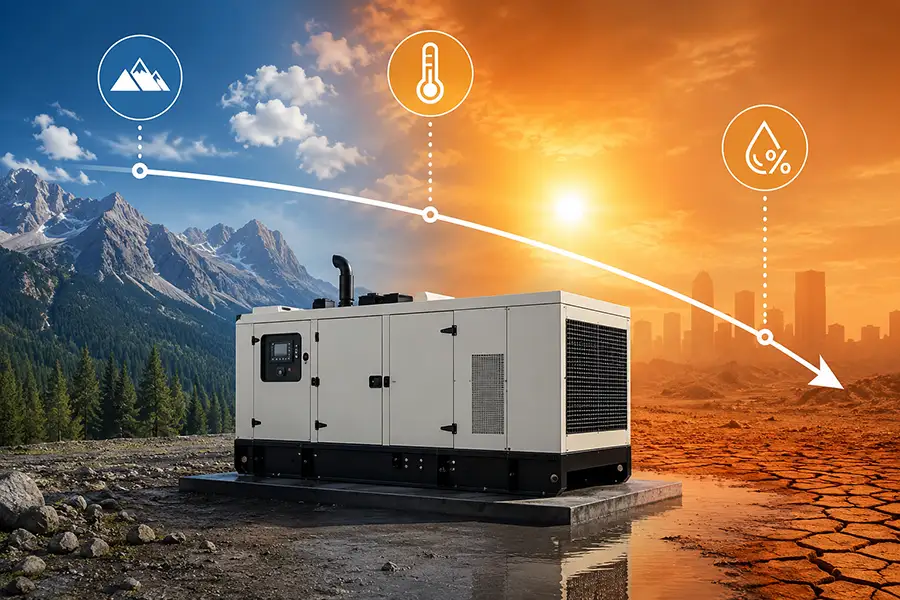
When specifying a commercial or industrial generator, many buyers focus on the nameplate rating. A generator listed at 1,000 kW is often assumed to provide 1,000 kW under all operating conditions. In reality, environmental conditions can significantly impact generator performance.
This reduction in available power is known as generator derating. Factors such as altitude, ambient temperature, and humidity can all reduce the actual output capacity of a generator system. Understanding how derating works is critical for facility managers, consulting engineers, contractors, and data center operators who depend on backup power systems to perform during outages.
In this article, we’ll explain what does engine derate mean, why generator derating occurs, how to estimate derated output, and what considerations should be made during system design.
What Is Generator Derating?
Generator derating refers to the reduction in a generator’s available output due to environmental or operating conditions that differ from standard manufacturer rating conditions.
Most generator manufacturers publish ratings based on specific reference conditions, commonly:
- Sea level elevation
- Ambient temperature of 77°F (25°C)
- Standard atmospheric pressure
- Controlled humidity conditions
When a generator operates outside these conditions, the engine may not be able to produce its full rated horsepower. Since generator output is directly dependent on engine performance, available electrical output is also reduced.
For this reason, a generator rated at 1,000 kW at sea level may only be capable of producing 900 kW or less when installed at a high-altitude location or in extreme heat.
What Does Engine Derate Mean?
Many people ask, what does engine derate mean, and the answer begins with the engine itself.
Internal combustion engines require three key elements to produce power:
- Fuel
- Air (oxygen)
- Proper combustion conditions
As altitude increases or temperatures rise, air density decreases. Less oxygen enters the engine cylinders during each combustion cycle. To maintain proper combustion and emissions compliance, the engine control system limits fuel delivery.
The result is reduced engine horsepower.
Because the alternator is driven by the engine, any reduction in available engine power translates into reduced generator output capability.
This process is known as engine derating, and it directly affects generator performance.
Why Altitude Causes Generator Derating
One of the most common reasons for generator derating is elevation.
Atmospheric pressure decreases as altitude increases. At higher elevations, air becomes less dense and contains less oxygen per cubic foot.
For naturally aspirated engines, this can have a dramatic impact on performance. Turbocharged diesel and natural gas engines generally perform better at altitude, but they still experience measurable losses.
A typical manufacturer guideline may require derating above 500 feet or 1,000 feet of elevation, depending on engine design.
Example
Consider a 1,000 kW diesel generator installed:
- Sea Level: 1,000 kW available
- 5,000 ft elevation: approximately 900-950 kW available
- 8,000 ft elevation: potentially 850-900 kW available
Actual values vary by manufacturer and engine model, but the principle remains the same.
This is why performing a generator derating altitude calculation is a critical part of system sizing.
Failing to account for elevation can result in a generator that appears adequately sized on paper but cannot support the required facility load during an outage.
How Much Does Heat Affect Generator Output?
Another common question is: How much does heat affect generator output?
The answer depends on the generator design and ambient operating temperature.
As temperatures rise, air density decreases. Even at sea level, hot air contains fewer oxygen molecules than cooler air.
High temperatures can affect:
- Engine combustion efficiency
- Turbocharger performance
- Cooling system effectiveness
- Alternator temperature rise
- Overall generator reliability
Many generator manufacturers apply derating factors once temperatures exceed their standard rating conditions.
For example, most generators are rated at standard ambient conditions of 77°F (25°C). As temperatures rise, decreasing air density and increasing cooling system demands can reduce available engine horsepower and generator output. While moderate temperatures around 95°F (35°C) may only have a minor impact, operating environments exceeding 104°F (40°C) can result in measurable derating. In extreme conditions approaching 122°F (50°C), the loss of available capacity can become substantial, making proper temperature-based derating calculations essential when sizing generators for hot climates.
A generator operating in Arizona, Texas, Nevada, or other hot climates may require substantial oversizing compared to an identical installation in a cooler region.
When evaluating generator kW derate temperature impacts, it is important to review the specific manufacturer’s performance curves rather than relying on generic assumptions.
Understanding Humidity’s Role
Humidity receives less attention than altitude and temperature, but it can still contribute to derating.
Moisture displaces oxygen within the air. As relative humidity increases, the amount of oxygen available for combustion decreases slightly.
Humidity alone generally produces a smaller effect than temperature or altitude. However, when combined with high temperatures and elevated locations, its impact becomes more significant.
This is especially important in:
- Coastal facilities
- Gulf Coast industrial plants
- Tropical environments
- Offshore operations
In these applications, engineers often evaluate all environmental factors simultaneously when calculating available generator output.
Generator Derating Factor Table
Although exact values vary by manufacturer, the following example illustrates a typical generator derating factor table concept.
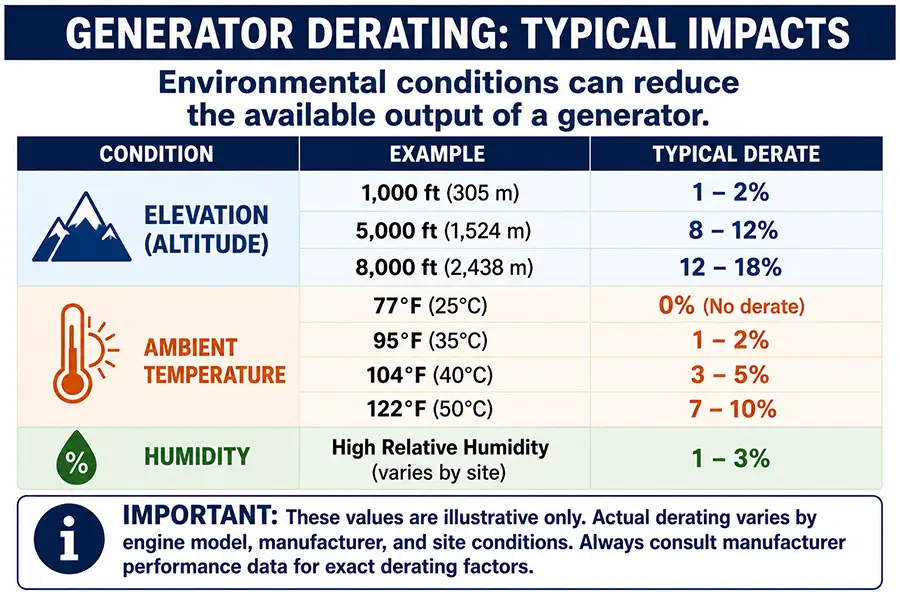
Always consult manufacturer documentation for exact performance adjustments. For mission-critical facilities, relying on generic derating assumptions can introduce substantial risk.
Diesel Generator Derate Formula
There is no single universal diesel generator derate formula because every engine platform responds differently to environmental conditions.
However, a simplified approach is often used during preliminary sizing:
Available Output = Rated Output × Altitude Factor × Temperature Factor
For example:
- Generator Rating: 1,000 kW
- Altitude Factor: 0.92
- Temperature Factor: 0.97
Available Output:
1,000 × 0.92 × 0.97 = 892.4 kW
In this scenario, a generator originally rated at 1,000 kW may only provide approximately 892 kW under actual site conditions.
This example demonstrates why environmental analysis should occur before equipment selection.
Why Derating Matters for Critical Facilities
Generator derating becomes especially important when supporting critical infrastructure where power continuity is essential.
Examples include:
Data Centers
Data centers frequently operate with limited margin for error. If a generator cannot carry the full critical load due to environmental derating, uptime objectives may be compromised.
Organizations planning data center backup power projects should carefully evaluate site-specific conditions and load growth projections. Learn more about backup power solutions for data centers here:
https://www.globalpwr.com/solutions/data-centers/
Construction Sites
Temporary power installations often occur in challenging environments that experience high temperatures, varying elevations, and rapidly changing load profiles.
Proper generator sizing helps avoid nuisance shutdowns and insufficient capacity during peak demand.
Learn more about construction power solutions:
https://www.globalpwr.com/solutions/construction/
Manufacturing Facilities
Industrial facilities frequently operate large motors, compressors, pumps, and process equipment with significant starting currents.
A derated generator may struggle to support these loads during startup, even if the nameplate rating appears adequate.
More information about backup power for manufacturing:
https://www.globalpwr.com/solutions/manufacturing/
Healthcare and Critical Infrastructure
Hospitals, water treatment facilities, emergency response centers, and telecommunications sites often rely on backup generators for life-safety and operational continuity.
Underestimating derating effects can create substantial operational risk.
Diesel vs. Natural Gas Generator Derating
Both diesel and natural gas generators experience derating, but the impact can differ.
Diesel generators generally provide:
- Higher power density
- Better transient response
- Stronger performance at varying loads
Natural gas generators offer:
- Continuous fuel supply in many locations
- Lower onsite fuel storage requirements
- Reduced emissions profiles
Both technologies require environmental evaluation during system design.
Learn more about:
Diesel Generators: https://www.globalpwr.com/diesel-generators/
Natural Gas Generators: https://www.globalpwr.com/natural-gas-generators/
How to Properly Size a Generator for Site Conditions
Proper generator sizing involves much more than calculating connected load.
A comprehensive evaluation should include:
- Site elevation
- Maximum ambient temperature
- Humidity levels
- Future load growth
- Motor starting requirements
- Fuel type
- Emissions requirements
- Local code compliance
Engineers should also evaluate the entire power system, including transfer switches, switchgear, UPS systems, and distribution equipment, to ensure compatibility and reliability across all operating scenarios.
For preliminary sizing assistance, tools such as a kVA-to-kW calculator can help establish baseline load requirements before detailed engineering analysis.
Final Thoughts on Generator Derating
Generator derating is one of the most overlooked factors in backup power system design. While a generator’s nameplate rating provides a useful starting point, actual site conditions ultimately determine how much power the system can deliver.
Altitude reduces air density. Heat reduces combustion efficiency and cooling performance. Humidity further decreases available oxygen for combustion. Together, these environmental factors can significantly reduce real-world generator output.
For commercial and industrial facilities, understanding generator derating helps avoid undersized systems, unexpected performance limitations, and costly redesigns.
Global Power Supply offers comprehensive critical power solutions, including generators, UPS systems, transfer switches, battery energy storage systems, engineering support, project management, and turnkey deployment services for mission-critical applications.
If you’re evaluating generator sizing for a new project, facility expansion, or equipment replacement, try our Power kVA/kW Calculator to estimate your power requirements:
https://www.globalpwr.com/power-kva-kw-calculator/
For projects involving unique site conditions such as high altitude, extreme temperatures, or demanding load profiles, contact Global Power Supply to speak with one of our power system engineers. We can help evaluate environmental derating factors and develop a backup power solution tailored to your facility’s operating requirements.